Explore the portfolio

Open to AI/ML and software engineering internships.

Gaurav Kumar Nayak / Portfolio 2026

GauravKumar Nayak.

Software engineering.
Applied AI. Real evidence.

CS student building reliable backends and useful AI tools. I care about what happens after the happy path.

Open to AI & software engineering internships

B.Tech · C.V. Raman Global University · Expected 2028

Scroll through the full portrait story

Curiosity

I turn
magic into
logic.

AI starts with a possibility. Engineering makes its behavior inspectable, testable, and useful.

Approach

Build it.
Break it.
Understand it.

Durable requests, explicit approvals, useful interfaces, and honest evaluation. The details are the work.

Selected work

The work.
And the evidence.

Explore the implementation, tradeoffs, measured behavior, and limits behind each project.

Explore projects

The work behind the words.

A closer look at the systems I am building: what they do, how they work, and where they still need work.

AI-assisted development. Current solo work and earlier team projects are labelled individually. Case studies distinguish implemented behavior, measured results, and limitations.

Discover all projects & repositories

A closer look / Kairos

Good systems make uncertainty visible.

Follow a request from acceptance to inspectable evidence.

Interactive architecture

From request to evidence.

An illustrated view of Kairos. Select a stage to inspect its responsibility.

Request

A registered investigation starts with a bounded request and a stable identity.

Different problems. Same curiosity.

Applied AI, optimization, collaboration, and developer tools. Each project opens into its own technical story.

ForgeGuard Contain workspace showing supplier-notice exposure and review state
Current containment workspace using synthetic records. The authored example path is labelled no model run.
Locally verified prototype

ForgeGuard Contain

Supplier-quality containment workflow

Turns a supplier notice into record-backed exposure, a revision-bound human decision, and durable inventory or task actions in a sandbox.

My workConnected lot tracing, revision-bound approval, durable sandbox receipts, and explicit pending inference states.

Authored fault scenarios
40 / 40
Stored local synthetic-fixture checks: stale approval, duplicate intent, fencing, lost acknowledgement, and recovery. Live model qualification remains open. Validation notes
  • React
  • FastAPI
  • PostgreSQL
  • Python

Why I built it

Supplier notices need traceable affected lots and approvals that remain valid only for the reviewed record revision.

What it does

  • Trace notices to affected demonstration lots
  • Approve the exact reviewed revision
  • Recover sandbox actions through durable receipts

How it works

  • React case register and review interface.
  • FastAPI with SQLite development storage and a PostgreSQL deployment adapter.
  • Bounded inference worker and sandbox inventory/task actions.
Design decisions
  • Invalidate stale approvals when the reviewed record changes.
  • Keep authored examples visibly separate from live model requests.
  • Show unavailable inference as pending instead of manufacturing a result.
Validation & limitations

What was checked

  • Stored local evidence records 40/40 authored fault scenarios covering stale approval, duplicate intent, fencing, lost acknowledgement, and recovery.
  • Real HTTP and PostgreSQL adapter checks exercise authority, revision, persistence, and receipts.

Current limits

  • Demonstration notices, records, and policies are authored synthetic fixtures.
  • Live model quality, AMD workload, and public deployment are not qualified.
  • A sandbox hold is a software state change. No factory savings or physical containment result is claimed.
HyperFlow BasketOps interface with workspace and reviewer connection controls
Current BasketOps interface in disconnected mode. No live purchase or backend result is shown.
Local engineering prototype

HyperFlow

Reviewable commerce workflows

A commerce prototype connecting basket optimization, approval boundaries, reconciliation, durable jobs, and experimental demand modeling.

My workImplemented solver-backed baskets and reconciliation, then strengthened action approval, workflow state, and experiment provenance.

Basket optimization
MILP
A solver-backed implementation with stock constraints and re-solving. This describes the algorithm, not measured sales impact. Validation notes
  • FastAPI
  • React
  • Python
  • MILP

Why I built it

An optimized basket still needs stock reconciliation, approval, and recoverable provider actions before it becomes an executed order.

What it does

  • Optimize baskets with stock constraints
  • Re-solve after cart reconciliation
  • Review approval state before provider actions

How it works

  • React workbench and FastAPI services.
  • MILP solver with stock constraints and reconciliation-driven re-solving.
  • Provider adapters, durable job paths, replay scenarios, and separate model fit/evaluation artifacts.
Design decisions
  • Keep a proposed basket distinct from an authorized provider action.
  • Re-solve after stock or cart constraints change.
  • Separate synthetic demand experiments from operational commerce metrics.
Validation & limitations

What was checked

  • Basket optimization uses an actual MILP solver; reconciliation adjusts constraints and re-solves.
  • Demand studies measure relative WMAPE improvement on synthetic censored rows, not recovered real sales.
  • These notes describe the current local workflow. No operational commerce benchmark or public receipt download is attached.

Current limits

  • No recovered revenue, live operational accuracy, or deployment-wide provider execution is claimed.
  • Older repository material can contain superseded claims. This case study describes the narrower current scope.
  • Authenticated provider execution depends on actual credentials and availability.
NexGrid Studio editor displaying labelled sample code and execution controls
Current local editor with labelled sample code. No active collaborative session or executed result is shown.
Collaboration prototype

NexGrid

Collaborative code editor

A shared coding workspace exploring CRDT synchronization, WebSocket collaboration, and code execution workflows.

My workBuilt a shared editing interface around CRDT synchronization, WebSocket events, and execution feedback.

Document synchronization
CRDT
Implemented collaborative document model. This preview has no active multi-user session; no concurrency scale is claimed. Validation notes
  • React
  • JavaScript
  • WebSockets
  • CRDT

Why I built it

Concurrent edits must converge while document state and execution feedback remain understandable.

What it does

  • Edit a shared CRDT document
  • Synchronize changes over WebSockets
  • Inspect execution feedback

How it works

  • Browser editor and workspace.
  • CRDT shared document with WebSocket synchronization.
  • Separate execution and result-presentation workflow.
Design decisions
  • Use a shared document model for concurrent changes.
  • Present execution feedback separately from document synchronization.
Validation & limitations

What was checked

  • Source and local interface demonstrate collaborative editing and execution workflows.
  • No published large-scale concurrency or latency benchmark is attached.

Current limits

  • Prototype status does not imply a hardened public code-execution service.
  • Inference-gateway throughput and accelerator results do not apply to this project.
CodeSage source explorer with sample files, definitions, and parsed call relationships
Current source explorer with a bundled local sample. Symbols and call edges are parsed from the displayed source; no model answer is shown.
Developer tooling prototype

CodeSage

Repository intelligence and graph inspection

Explores code through AST call graphs, dense and lexical retrieval, and an interface for inspecting repository relationships.

My workConnected AST-derived relationships to dense/lexical search and inspectable repository context.

Retrieval paths
Dense + lexical
Implemented code-context retrieval paths. This preview shows a labelled local sample, not a retrieval-quality benchmark. Validation notes
  • Python
  • FastAPI
  • React
  • AST

Why I built it

Understanding a repository requires definitions, calls, and relationships as well as matching text.

What it does

  • Inspect AST call relationships
  • Search code with dense and lexical retrieval
  • Explore indexed repository context

How it works

  • Python source parsing and graph construction.
  • Dense and lexical retrieval over indexed code.
  • React graph interface and experimental training tools.
Design decisions
  • Keep structural relationships alongside retrieved text.
  • Expose selected context for inspection.
Validation & limitations

What was checked

  • Current source contains parsing, retrieval, graph inspection, and experimental training paths.
  • No qualified H100 training, universal context-size, or model-accuracy result is claimed.

Current limits

  • Graph completeness depends on parser coverage and dynamic code behavior.
  • Experimental training tooling does not establish trained model quality.
QualEdge model and OOD controls with pending pipeline stages
Current model and OOD controls with pipeline stages pending. No NPU measurements or completed run are shown.
Optimization workbench

QualEdge

ONNX optimization workbench

Compares quantization and execution-provider options while retaining accuracy gates, benchmark context, and fallback behavior.

My workBuilt ONNX candidate comparisons with accuracy gates and explicit provider fallback.

Optimization acceptance
Accuracy gated
Candidates are checked against accuracy constraints. No device-specific speedup or NPU run is established by the preview. Validation notes
  • Python
  • ONNX Runtime
  • React
  • Quantization

Why I built it

A faster model is not useful when accuracy regresses or the preferred execution provider is unavailable.

What it does

  • Compare ONNX optimization candidates
  • Reject accuracy regressions
  • Inspect execution-provider fallback

How it works

  • ONNX optimization and quantization pipeline.
  • Provider benchmarking and accuracy comparisons.
  • Browser workbench for results, rejected candidates, and fallback state.
Design decisions
  • Check accuracy before accepting an optimization.
  • Preserve the measured runtime and device context.
Validation & limitations

What was checked

  • Local workbench supports benchmark comparisons and accuracy-regression rejection.
  • Hardware-specific results require actual device receipts; no blanket NPU speedup is claimed.

Current limits

  • Results are specific to model, data, provider, and device.
  • Provider availability does not prove accelerator execution on an unmeasured device.
Browse the project archive

Small steps, committed.

203 contributions in GitHub’s published calendar.

GitHub profile

The calendar reflects activity visible on the public profile. Explore the code and project notes for the engineering itself.

Practice beyond personal projects.

FlyRank

Machine Learning Engineering Intern program

Completed internship program

FlyRank

July 1 – August 12, 2026

Completed the six-week program during the stated dates. The original acceptance letter, approved June 27, 2026, records the role and July 1–August 12 schedule. It is not a completion certificate or evidence of client impact.

  • Developed applied machine-learning and software engineering skills during the program.
  • Personal portfolio projects are documented separately from the program. No client revenue, production deployment, or employer-owned project result is attributed here.
View program document

Tools mean more
when you can show the work.

Capabilities demonstrated in the projects above. Open the evidence to see the implementation, tradeoffs, and limits.

Applied AI & evaluation

Connect model workflows to inspectable context and evaluate them with visible limitations.

  • scikit-learn
  • Retrieval
  • AST
  • Model evaluation
  • ONNX

Frontend & interaction

Make saved state, review decisions, and failure states understandable in a browser.

  • React
  • Next.js
  • TypeScript
  • JavaScript
  • CSS
  • WebSockets

Data & delivery

Preserve exact results, compare model candidates, and exercise software through behavioral checks.

  • SQLite
  • PostgreSQL
  • Docker
  • Git
  • CI
  • Behavioral testing

Always learning. I use documentation and AI tools during development; the linked case studies show what I have built and validated.

Learning by building.
Growing by testing.

I am a computer science undergraduate building AI and software systems, from inspectable code repair to durable action execution and transaction replay. I care about understandable interfaces, recoverable workflows, and evidence that shows both what works and what still needs work.

Education

B.Tech in Computer Science and Engineering, C. V. Raman Global University · Expected 2028

How I work

AI-assisted development. Current solo work and earlier team projects are labelled individually. I document validation and limitations alongside the features.

What is next

Open to AI/ML and software engineering internships.

What changed as I kept building.

A few real chapters, with the work and records behind them.

  1. 2025

    Getting the foundations right

    SQL coursework and early application projects gave me a practical way to learn how software and data fit together.

    Udemy
    Learning records
  2. 2026

    Learning through the work

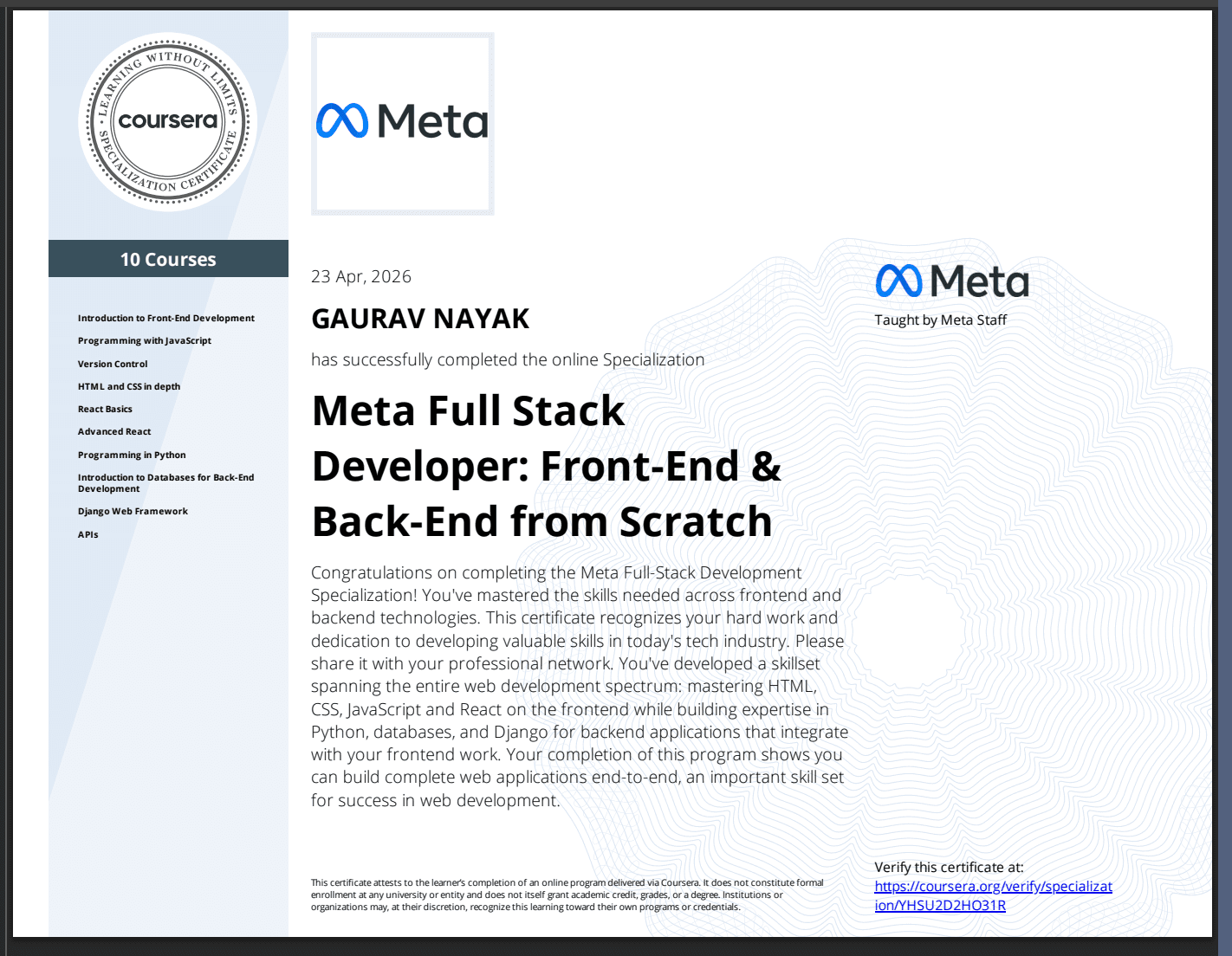
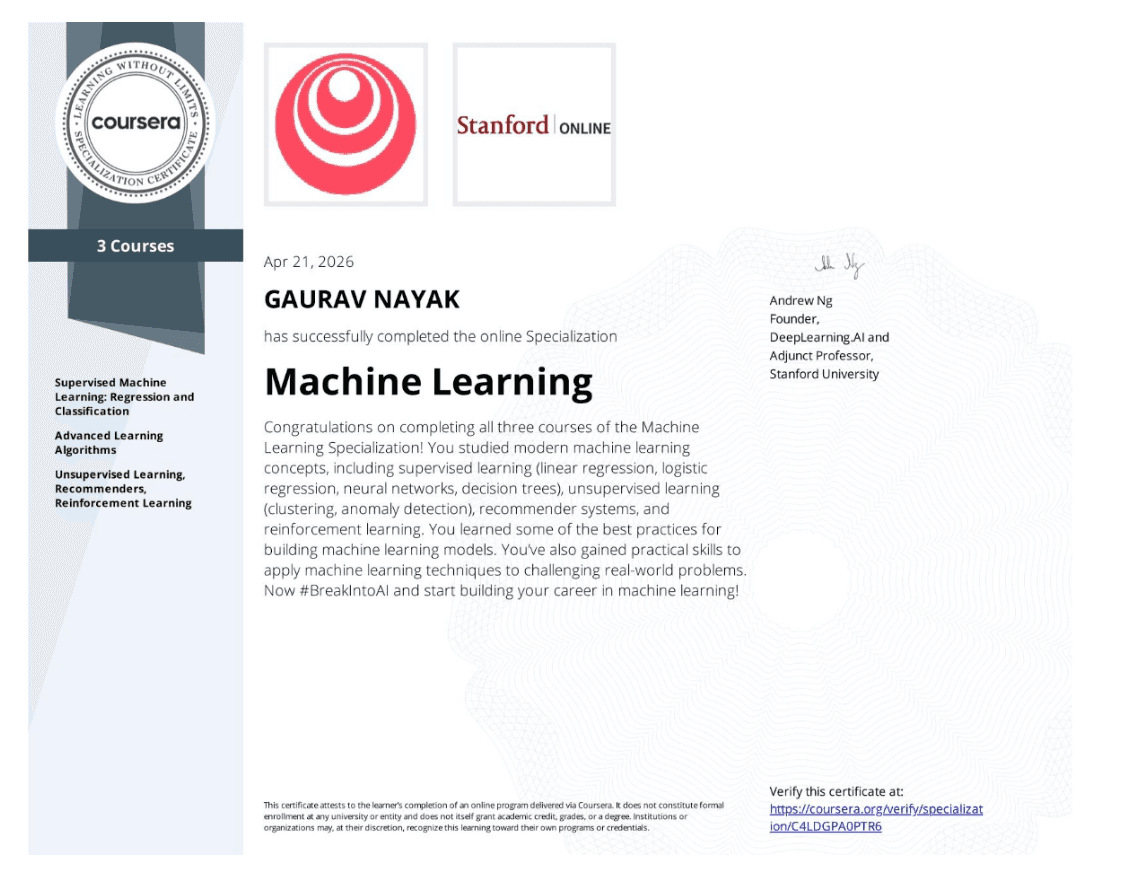
    Machine learning and full-stack coursework, followed by projects in retrieval, recommendations, and collaborative interfaces.

    MetaIBMStanford OnlineDeepLearning.AI
    Projects and repositories
  3. July – August 2026

    A structured program

    Completed the FlyRank Machine Learning Engineering Intern program, July 1–August 12. Personal projects remain documented separately.

    FlyRank
    Program experience
  4. October 2026

    Asking harder questions

    Added durable requests, recovery checks, reproducible evaluation, and clearer evidence. Failed model checks now stay beside the software results.

    Engineering evidence

Milestones, with context.

Selections, participation, and completed learning are described separately, with the available source attached.

MetaHugging FaceScaler

Finalist selection

2026

OpenEnv AI Hackathon

Meta · OpenEnv · Hugging Face · Scaler

My team was selected among 800 finalists from 31,000+ registered teams. The saved selection notice names Gaurav Kumar and the Bangalore finale on April 25–26. This is finalist selection, not an overall win or a global rank.

Original document
IISc BangaloreArtPark

Participant

2026

ArtPark CodeForge Hackathon

ArtPark · IISc Bangalore

Participated in the build-and-submit prototype development round with SkillBridge, a learning-path prototype.

Original document

Courses, workshops, and events.

Each mark connects to a named record in the library.

IIT BombayIIT BombayIIT RoorkeeIIT RoorkeeIIT GuwahatiIIT GuwahatiIIT DelhiIIT DelhiNIT RaipurNIT RaipurNIT DurgapurNIT DurgapurIISc BangaloreIISc BangaloreMetaMetaHugging FaceHugging FaceIBMIBMStanford OnlineStanford Online

Thinking, written down.

Articles and technical case studies, labelled for what you will find when you open them.

Let’s build
something useful.

Open to AI/ML and software engineering internships. I would love to discuss the engineering behind these projects and what I could contribute to your team.

gauravnayak711@gmail.com

This form sends your message through Formspree.

Find your way

12 results found.

Use Tab or arrow keys to explore. Enter opens a result. Escape closes search.

Portfolio assistant

Answers from published portfolio records.

A closer look

Find the work behind the skills.

Ask about engineering decisions, validation, experience, or project limitations. Each answer links back to its sources.

AI can make mistakes. Check the linked records. Your question is sent to Google Gemini.